Thursday, June 30, 2011

Varnish pastel experiment

charcoal sketch on prepared panel
 Pastels have to be framed under glass to protect them. Glass is heavy. Glass can break during shipping and needs extra care. Plexiglass is an alternative but can generate static electricity. Static electricity can pull loose pastel dust and create a cloud on the inside of a framed piece. Plexiglass can also be less rigid than glass, and when used on large paintings (like my 4 foot square painting earlier this Spring) it can even dip onto the painting surface. What a pain!

So, that's the problem. I love pastel. I hate glass. Can I successfully varnish a pastel painting without having it change the beauty of the pastel?

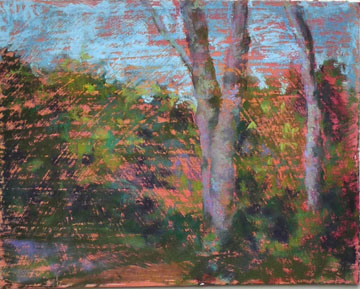
original pastel painting, no varnish
 I created this small painting of birch trees. Gatorboard support with acrylic gesso, acrylic underpainting, acrylic pumice gel, and pastel on top.

Golden Archival Varnish, Mineral Spirit Acrylic Aerosol
 I thought I might be able to create an acrylic sandwich by using Golden's Archival Varnish Mineral Spirits Acrylic Aerosol.

Spray in a well-ventilated place, in my case outdoors under the overgrown Christmas tree. I sprayed the piece and let it dry for at least 20 minutes between coats. Five layers of varnish. 

What I found: 
1. When the first spray of varnish hit the pastel, all of the little pastel particles that were loose, suddenly became solid and obvious. Next time I will give the piece a sharp smack on the back to get rid of the loose stuff before I spray varnish on it.

2. The color darkened, but not as much as I expected. 

3. The pastel lost something when varnished. With the first layer of varnish, I lost my ability to change the painting, to add or remove pastel. And, the pastel became more plastic and less elegant. 

Overall, I was pleased with the results and I will try this again on a larger panel painting. Once the aerosol varnish sets up a protective surface on the painting, I can use a brush to add more layers of varnish, and to give the piece a different look. 
spray in a well-ventilated area
final result, varnished pastel painting on prepared panel

Tuesday, June 28, 2011

... selects her own Society

12 x 7
charcoal, gouache, pastel, graphite on paper

First a graphite drawing, then charcoal to shape and block in. Paper towel and brush to wipe away detail, block in shapes. Then color, the golds and greens and feeling of the inside of a treasure trove with gouache. The calligraphy of pastel and the feel of the drape barely concealing the pink flesh.

Finally, the words, just phrases from Emily Dickinson's "The Soul Selects" poem. Read here by Julie Harris, when she played "The Belle of Amherst," in 1976.

The Soul selects her own Society --
Then -- shuts the Door --
To her divine Majority --
Present no more --

Unmoved -- she notes the Chariots -- pausing --
At her low Gate --
Unmoved -- an Emperor be kneeling
Upon her Mat --

I've known her -- from an ample nation --
Choose One --
Then -- close the Valves of her attention --
Like Stone --

Sunday, June 26, 2011

Three steps for the Yellow-Capped Blackbird

charcoal sketch

gouache added

pastel for the finish
This painting process is a variation on a technique I learned at Dawn Emerson's workshop. It takes time to practice and experiment in order to make something my own, and that's my arrival point today. This technique is MINE.

Too bad I didn't correct the composition problems before taking this piece to the finish. Next time around I will give the bird room for his tail feathers!

Saturday, June 25, 2011

Juicy treat

9 x 13
charcoal, gouache, pastel on paper

Mussels appeared with the extra low spring tide, a juicy treat for observant birds.

Friday, June 24, 2011

It figures, more from Dawn Emerson

Instructions:  break up the composition space first with a grid of not necessarily straight, not necessarily equivalent lines. At least five of them. Then, draw your figure. How is your drawing influenced by the grid? What happens when you add color?

Instructions: with as few marks as possible, indicate the figure. What did you include? What did you leave out? 

I love the uninhibited, almost primitive look of these drawings. It's all too easy to take a workshop, get excited while I am there, and then leave with a case of instant amnesia. I lose the breakthroughs I began. But I am retracing some of my steps, to find the hints and clues to another way.

Do you know Beth Hart? Her music and this song get at this turmoil.
She's worth knowing, especially if you can relate to this: I don't want to survive, I want to live!

Thursday, June 23, 2011

Tool -- new and cool

I'm pretty sure that I've seen it before, but at Dawn Emerson's workshop earlier this month, I saw this tool again. Not only saw it, but saw it being used. 

If you are working on tuning up your color harmonies in your paintings, like I am, allow me to recommend this tool to you. The "Analogous Color Wheel" lets you dial up the main colors in your painting, and shows you which colors complement and are discords. Is you painting mostly blue (as I have dialed in above)? Then orange is the complement and yellow green and red violet can offer some discord pops. Where to get this nifty tool? I bought mine through Dakota Art Pastels here.
And that brings me to a question Casey Klahn threw at me during his recent workshop in town: what would happen if you just turned the color wheel and painted this piece again, but one click to the right or left? I am working on that one.

Do you have a new favorite art tool? Do tell!

Tuesday, June 21, 2011

Storms over cranberry bogs

12 x 16, pastel on BFK
Not many places are just right for cranberry growing, but the Long Beach peninsula is one such place. Have you ever seen a cranberry bog? Of course, the berries are red, but so are the plants. Big fields of burgundy red growth that seem to wait patiently under stormy skies.

Monday, June 20, 2011

Feast

Low Tide Feast
8 x 13
mixed media on paper

Enjoy Keith Jarrett here.

Sunday, June 19, 2011

Happy Father's Day

My father is a great man. A real gentleman. He was raised in Illinois and in his growing up years he was exposed to farming (cousins Tommy and Margaret), car mechanics (his father), kindness (his mother), music (his father again and friend Thelma). When he went to college, though, he took up Electrical Engineering. He was a true "Fighting Illini."

Over the years, he worked at various defense contractor positions. He could never talk about his work at home because his work was top secret, so I thought he was a train engineer for the longest time. Kids. They will always sharpen your sense of humor, won't they?

Dad helped me with my Math homework. Dad studied my report cards and told me he was proud of me. Dad always listened to me play the piano and would wipe tears at my recitals. 

Some of you know that in the last year, my siblings and I helped Dad decide to move to an assisted living facility in Florida. He is doing well, has made some friends, and has gained some weight. He spends a lot of great time with my brother and his family. And he has been diagnosed with dementia and short term memory loss. 

In her book, "Finding Water: the Art of Perseverance," Julia Cameron talks about the importance of having encouraging and optimistic people in our lives. She calls them "believing mirrors" who "reflect back to you your competency and potential."

My father has always been one of my believing mirrors. He would tell me how proud he is of me, and celebrate my successes and accomplishments with an epic poem like account of my previous successes. He believed in me without hesitation and only asked which new mountain I was planning to tackle next.

Not now.

And that is a painful loss.

So, Happy Father's Day, Dad. I love hearing how happy you are when I call and the cheerfulness you have about your life. Never do I hear a complaint or a negative word. Your caregivers love you to pieces and can't say enough positive about you. You are a great man. A real gentleman. You were my #1 believing mirror. And I miss you.

Saturday, June 18, 2011

Chinook start and finish

Charcoal, acrylic pastel ground on Rives BFK is the recipe for this start. I painted many starts at once and have been finishing them more slowly. I actually like the starts so well that I may leave some in their Notan form and not add any pastel on top.

Chinook
11 x 17
pastel on top of charcoal start